

Technical Team Fully Committed to R&D and Commissioning of Low Temperature Chiller
Recently, Hope Deepblue’s R&D team has been stationed at the product testing center, dedicating themselves entirely to the R&D and commissioning of low temperature absorption chiller. Through professional dedication and meticulous craftsmanship, they are overcoming core technical challenges to develop high-performance, highly reliable, and highly adaptable low temperature LiBr absorption chiller.
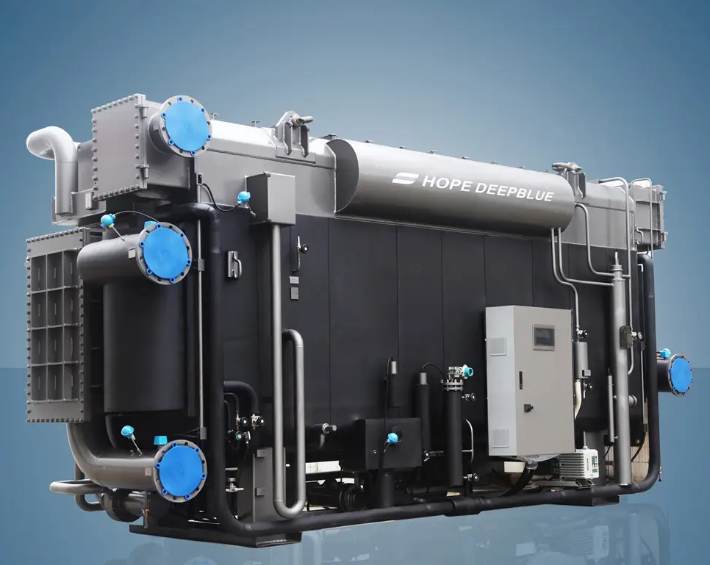
Stepping into the company’s product testing center, one sees large-scale low temperature units fully assembled and in place, with various pipelines, instruments, and control systems arranged in an orderly fashion. The commissioning site buzzes with intense yet organized activity. Personnel from R&D, technical, and testing departments have moved to the front lines of equipment operations, conducting comprehensive and meticulous commissioning work focused on the core performance of the low temperature absorption chiller. Team members collaborate closely, dividing tasks to systematically conduct parameter verification, performance testing, operational simulations, and potential hazard identification—covering everything from the equipment’s mechanical structure, heat exchange systems, power modules, and control systems to safety protection devices.
Given the unique application context of low-temperature LiBr absorption chiller, the standards for operational stability, heat exchange efficiency, energy efficiency, and safety reliability far exceed those of conventional equipment. To address industry pain points such as ice formation in low-temperature chilled water, insufficient temperature control accuracy, and poor long-term operational stability, the R&D team remained on-site, repeatedly conducting simulated low-temperature operating condition tests. They monitored the unit’s operational data in real time, precisely analyzed operating curves, and systematically discussed and optimized key aspects—including component compatibility, system piping optimization, program logic debugging, and anti-freezing structural upgrades—without overlooking a single detail or data point.
During the debugging process, technicians grounded their work in actual equipment operation, exchanged insights on technical challenges, and generated innovative ideas. They promptly adjusted plans and optimized designs in response to issues encountered, continuously refining the unit’s core performance. With a rigorous scientific attitude and solid professional expertise, the team worked day and night to overcome challenges and pursue perfection. They dedicated themselves to breaking through key technical bottlenecks in -low-temperature refrigeration, driving product iteration and upgrades, and striving to create Hope Deepblue’s low-temperature LiBr absorption chiller that is capable of withstanding extreme conditions, delivers leading performance, and boasts exceptional quality.
Post time: Jun-04-2026


