

The Vapor-Liquid Separation Guard of Libr absorption chillers
In the internal structure of Libr absorption chillers, apart from core components such as solution circulation systems, heat exchangers and shield pumps, there is a easily overlooked yet essential device — the liquid baffle, also commonly known as a mist eliminator. Installed discreetly in the vapor passages between the generator and condenser, as well as between the evaporator and absorber, it features a simple structure but serves as a key component for ensuring medium purity, eliminating common operational faults and maintaining high-efficiency operation, and is regarded as the built-in “vapor-liquid separation guard” of the chiller unit.
Libr absorption chillers complete heat exchange and refrigeration cycles relying on vapor circulation. Under high-temperature heating conditions, the concentrated lithium bromide solution in the generator boils violently and generates a large amount of refrigerant vapor. During the boiling process, high-speed flowing vapor tends to entrain tiny lithium bromide solution droplets, causing vapor entrainment. Without effective interception, saline lithium bromide droplets will flow into the condenser along with vapor and eventually enter the refrigerant water system of the evaporator, resulting in refrigerant water contamination, which is one of the core causes of unexplained cooling capacity attenuation. The primary function of liquid baffles is to eliminate vapor entrainment fundamentally.
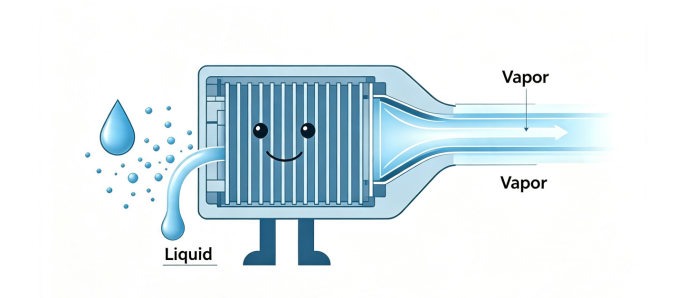
Liquid baffles are mostly designed with louvered, folded baffle or wire mesh structures, achieving vapor-liquid separation through airflow deflection and impact principles. When vapor mixed with fine liquid droplets passes through the baffle, gaseous vapor flows through the passages smoothly, while liquid droplets with higher mass continuously collide with the baffle surface, aggregate and condense into large droplets. Under the effect of gravity, the collected liquid droplets flow back to the generator cavity, realizing thorough separation of vapor and solution and ensuring that only pure refrigerant vapor enters the condenser.
In addition to the core protective function on the generator side, the liquid baffle installed between the evaporator and absorber is also indispensable. The refrigerant water in the evaporator absorbs heat and evaporates to produce refrigeration effect, and high-speed vapor may carry a small amount of refrigerant water droplets. The liquid baffle intercepts these droplets and allows them to fall back to the evaporator water tray for cyclic utilization. It prevents refrigerant water from directly entering the absorber and being absorbed by lithium bromide solution, effectively reducing refrigerant water loss, avoiding abnormal dilution of solution concentration, and keeping the solution concentration within the reasonable operating range.
During daily operation and maintenance, the working condition of liquid baffles directly affects unit stability. After long-term operation, corrosive impurities and solution scaling will adhere to the baffle surface, block vapor passages and increase vapor flow resistance, leading to elevated internal pressure difference, unsmooth vapor circulation and reduced heat transfer efficiency. Once the liquid baffle is deformed, damaged or detached, its vapor-liquid separation function will fail completely, aggravating vapor entrainment and frequent refrigerant water contamination. This will directly cause a sharp drop in cooling capacity and abnormal increase in energy consumption of the chiller unit.
Post time: Aug-11-2026


