

What Is the Difference Between Absorption Refrigeration and Vapor Compression Refrigeration?
Vapor compression refrigeration and absorption refrigeration represent the two mainstream technical routes for commercial building and industrial cooling projects. While both systems can produce chilled water to meet air conditioning and process cooling demands, many engineering purchasers only notice identical end results without understanding the fundamental gaps in their operating principles. Clarifying the operating logic and core differences of the two cycles facilitates proper equipment selection based on project energy conditions, and enables full recognition of the unique application value of lithium bromide absorption chillers.
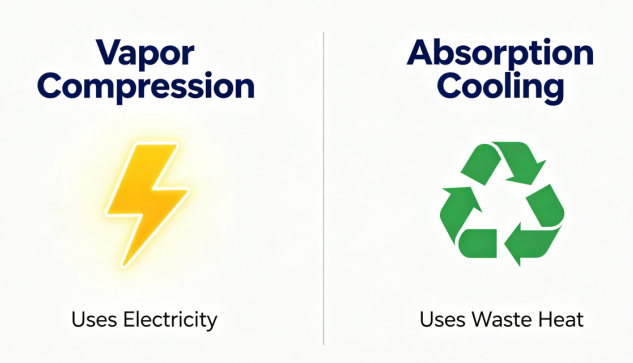
Vapor compression refrigeration is currently the most widely adopted cooling method, implemented by screw, centrifugal and scroll chillers. The core component of the cycle is the compressor, which is electrically driven to compress gaseous refrigerant. High-temperature and high-pressure refrigerant flows into the condenser to release heat to the surroundings, then passes through an expansion device for pressure and temperature reduction. Low-temperature liquid refrigerant enters the evaporator and absorbs heat from chilled water to realize cooling. The vaporized refrigerant returns to the compressor to sustain continuous circulation. Simply put, vapor compression refrigeration relies on electric power to raise refrigerant pressure, and electricity serves as the primary energy source to maintain cooling operation. The refrigerant circuit inside the unit mostly operates under positive pressure, featuring flexible load regulation and fast start-stop response. It can stably supply cooling capacity at sites with sufficient power supply.
The most typical equipment adopting absorption refrigeration is the lithium bromide absorption chiller. Its most prominent feature is the absence of a compressor. The system operates with a working fluid pair, generally using water as the refrigerant and lithium bromide solution as the absorbent. The entire cycle is thermally driven; heat sources such as steam, high-temperature hot water, direct gas combustion heat and industrial process waste heat can provide energy. The heat source heats dilute lithium bromide solution to separate water vapor. After condensation, the water vapor enters the evaporator to absorb heat through evaporation and generate chilled water. The evaporated water vapor is then absorbed by concentrated lithium bromide solution to regenerate dilute solution for repeated circulation. The system primarily consumes thermal energy, whereas electricity only powers auxiliary equipment including solution pumps and vacuum pumps, accounting for a minimal proportion of total energy consumption. The main refrigeration circuit operates continuously under vacuum negative pressure, forming a sharp contrast with the positive-pressure operation of vapor compression chillers.
Differences in driving energy lead to comprehensive distinctions between the two types of equipment. Vapor compression refrigeration heavily relies on electricity and can operate independently without heat sources, making it suitable for office buildings, shopping malls and other sites equipped only with mains power. Absorption refrigeration cannot function without heat supply and is more applicable to factories with surplus heat. In terms of operating characteristics, vapor compression chillers deliver relatively stable energy efficiency under frequently fluctuating partial loads. Lithium bromide chillers perform better under long-term stable continuous operation, and impose strict requirements on vacuum tightness. Routine maintenance focuses on preventing vacuum leakage and preserving the quality of lithium bromide solution. Differences also exist in export compliance. Pressure-bearing pipelines of vapor compression chillers generally require assessment for relevant certifications. The vacuum refrigeration circuit of lithium bromide chillers is exempt from pressure equipment regulations, while units using steam or high-pressure hot water heat sources need additional compliance with pressure equipment standards.
By comparison, lithium bromide absorption chillers possess multiple distinctive advantages. Firstly, they offer flexible energy utilization. Waste heat from steel plants, chemical factories, power plants and other facilities can be recovered and converted into cooling capacity. Waste thermal energy that would otherwise be directly discharged helps enterprises substantially cut electricity costs, matching the demands of industrial energy-saving retrofits. Secondly, the unit has fewer moving parts, resulting in lower vibration and operating noise, which fits factories and buildings with stringent noise requirements. Water acts as the refrigerant without fluorocarbons, producing no greenhouse gas emissions. It boasts outstanding environmental performance and is free from restrictions under various refrigerant control policies. In addition, multiple models are available to accommodate different heat sources including steam, hot water and direct combustion, granting high flexibility for energy scheme design.
Neither cooling technology has absolute advantages or disadvantages; suitability depends on application scenarios. Electric-driven vapor compression refrigeration is versatile and serves as the conventional choice for projects without waste heat. Thermally driven lithium bromide absorption refrigeration delivers remarkable energy-saving benefits for industrial projects with surplus heat sources. Fully understanding the principle differences between the two technologies and selecting equipment according to on-site energy resources allows construction of cooling systems with balanced economy and stability.
Post time: Aug-07-2026


